US Retail Sales (Total)
US Retail Sales (Apparel)
| Month | All items | Core CPI | Apparel |
|---|---|---|---|
| 24-Jan | 3.1% | 3.9% | 0.1% |
| 24-Feb | 3.2% | 3.8% | 0.0% |
| 24-Mar | 3.5% | 3.8% | 0.4% |
| 24-Apr | 3.4% | 3.6% | 1.3% |
| 24-May | 3.3% | 3.4% | 0.8% |
| Month | All items | Core CPI | Apparel |
|---|---|---|---|
| 24-Jan | 3.1% | 3.9% | 0.1% |
| 24-Feb | 3.2% | 3.8% | 0.0% |
| 24-Mar | 3.5% | 3.8% | 0.4% |
| 24-Apr | 3.4% | 3.6% | 1.3% |
| 24-May | 3.3% | 3.4% | 0.8% |
Navigating Evolving Demand, Private Brand Premiumization, and Channel Dynamics
The U.S. retail landscape is currently navigating structural shifts shaped by evolving health demographics, inflation fatigue, and ongoing margin dynamics. Consumer behavior is showing a distinct bifurcation: sustained value-seeking on everyday essentials alongside a significant surge in wardrobe replacement demand prompted by widespread physical body shape changes. In response to these trends, the industry is observing a shift away from mass discounting. Key strategic focus areas are emerging around full-price discipline on core items, the continued premiumization of Private Brands (PB) as standalone growth drivers, and the evolution of off-price channels into active customer acquisition touchpoints.
(Jul 12, 2026 – Aug 11, 2026)
Consumers experiencing weight loss are not just sizing down their current clothes, but are actively shifting to entirely new brands. Replacement demand is exploding particularly in categories where fit is paramount, such as denim (90%), workwear (77%), and occasion wear (76%). During their physical transition, these customers prioritize reasonable prices, high stretchability, and adjustable fits over long-term investment pieces.
Publication Date: August 6, 2026
Source : ChainstoreageHoliday shopping is starting earlier, with 71% of consumers beginning before Black Friday and 46% before November. Furthermore, 67% of shoppers (and 80% of Gen Z) actively use AI tools in the early stages of shopping for gift ideas and price comparisons. Products lacking structured attributes easily recognized by AI—such as size, material, delivery date, and gift suitability—will be omitted from recommendations. This necessitates moving holiday campaigns and product preparations forward to August-October to capture early traffic.
Publication Date: August 4, 2026
Source : RetaildiveAccording to retail analysis firm IGD, successful large retail chains in the global grocery and apparel markets have abandoned the outdated pattern of simply copying national brands (NB). Leveraging their unique channel dominance, they have placed 'signature premium PB collections' featuring exclusive designs and specialized functions at the forefront of their stores. This has successfully attracted highly loyal, high-income shoppers along with the perception that these products offer superior quality compared to national brands.
Publication Date: July 30, 2026
Source : IGDIn the US back-to-school market, traditionally a major sales peak, consumers are prioritizing essential school supplies and learning electronics over apparel due to prolonged high inflation. Shopping patterns are shifting from bulk fashion purchases to selective buying based on specific events or immediate needs. Consequently, standalone promotional efforts by apparel retailers tied to traditional retail calendars are no longer yielding the robust results of the past.
Publication Date: July 29, 2026
Source : RetaildiveThe retail industry in 2026 is characterized by accelerating AI innovation and fierce price competition between manufacturers and distributors to counter rising tariffs. The scale of private brand (PB) products driven by large retail conglomerates is expanding significantly, and the dominance of retail platforms is strengthening to unprecedented levels. As the market concentration of mega-platforms like Walmart, Amazon, and Costco increases, small and medium-sized traditional brands are facing severe survival pressure.
Publication Date: July 28, 2026
Source : Vertex AI SearchTracking distribution performance data across major consumer goods channels reveals that private brands (PB) now account for nearly 25% of total sales volume. Consumers, made more rational by the prolonged economic downturn, have begun to trust PB products not as cheap imitations, but as smart alternatives that offer high satisfaction at reasonable prices. Capitalizing on this shift in perception, large retailers are aggressively expanding premium PBs beyond food and hygiene into apparel and home living categories.
Publication Date: July 28, 2026
Source : Vertex AI SearchThe top 10 omnichannel trends driving retail success have been reaffirmed, including AI- personalized curation, mobile-first commerce, AR/VR virtual fitting, social commerce integration, and predictive data-driven logistics. Only retailers who maintain consistent shopping data without disconnects between online and offline channels are successfully defending their average order value and maintaining high lock-in rates among loyal customers throughout the customer journey.
Publication Date: July 27, 2026
Source : Vertex AI SearchUS retail sales maintained a solid month-over-month increase for the ninth consecutive month, proving robust consumer purchasing power despite inflation concerns. The growth was driven by early summer discount promotions at department stores and multi-brand shops, along with a strong increase in apparel and accessories purchases. With apparel spending showing positive momentum despite economic anxiety, fashion companies are aggressively positioning their inventory for the Q3 back-to-school and fall seasons.
Publication Date: July 18, 2026
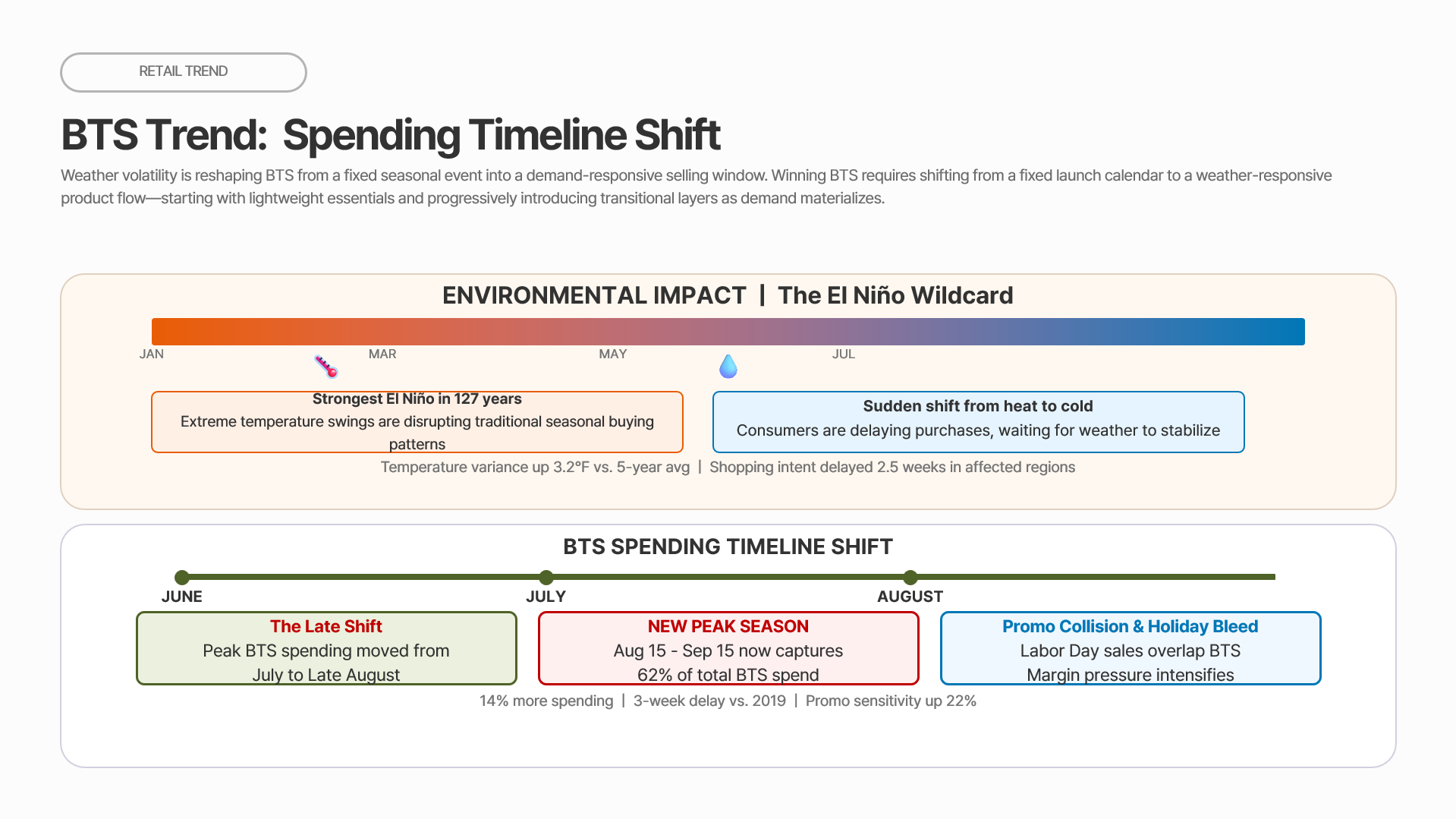
Source : Vertex AI SearchAccording to the NRF and CNBC Retail Monitor, US apparel and accessories sales in June grew significantly by 0.63% month-over-month and 13.65% year-over-year unadjusted. Early large-scale promotions by retailers and maintained disposable income based on employment stability synergistically pulled forward the back- to-school shopping demand earlier than usual. To respond to this earlier peak season, major retailers are rushing to focus on early fall apparel sales strategies.
Publication Date: July 18, 2026
Source : NRF/CNBCSam's Club, a Walmart-owned warehouse club, hosted a large-scale 'Sam's Wellness Club' event in Manhattan, inviting famous creators and buyers. Shifting away from a low-price image, the retailer prominently displayed sustainable loungewear and athleisure made from recycled leather and eco-friendly organic yarn under its 'Member's Mark' brand. As consumer criteria shift from simply 'cheap' to 'premium value at a reasonable price', over 90% of their apparel lines are being aggressively revamped with high-value lifestyle themes.
Publication Date: July 17, 2026
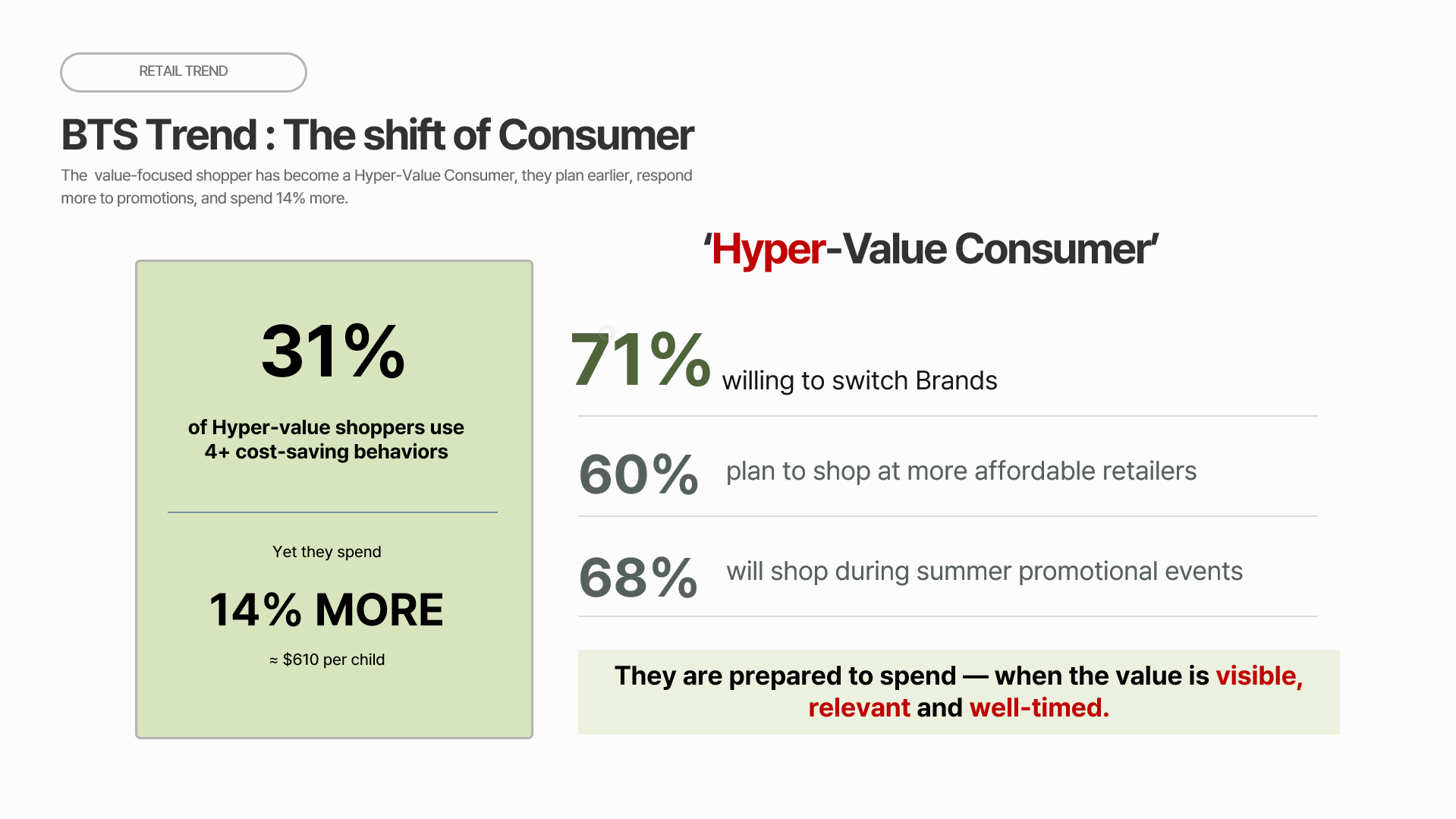
Source : Vertex AI SearchAccording to a 2026 back-to-school consumer survey, 51% of parents stated they would choose large retailers' private label (PB) brands over famous national brands due to accumulated inflation fatigue. Mass merchants offering one-stop shopping have overwhelmingly surpassed department stores as the top preferred shopping channel. Extreme rational consumption, prioritizing cost-effectiveness and practicality, is solidifying as the new normal.
Publication Date: July 14, 2026
Source : RetaildiveThe off-price market is eroding the market share of traditional department stores through flexible purchasing, rapid inventory turnover, and a treasure-hunt shopping experience. Off-price is evolving from a simple clearance channel into a continuous distribution structure strategically utilized by brands. However, as AI-based inventory optimization reduces brand overstock, securing high-quality closeout volume may become challenging. Brands must carefully balance the benefits of inventory monetization with preventing channel conflict and brand dilution.
Publication Date: August 6, 2026
Source : WWDAmerican Eagle is investing $41 million in a new distribution center in North Carolina, aiming for operation by early 2027. This hub can reach 150 million people within a one-day radius, drastically reducing inventory travel distance and online order delivery times. This regional placement improves the rapid replenishment of popular SKUs, integrates store inventory utilization, and enhances delivery accuracy. The increased fixed costs are expected to be offset by reduced transportation expenses and improved service levels.
Publication Date: August 3, 2026
Source : RetaildiveWith the rapid proliferation of e-commerce malls driven by independent designers and influencers, the market for customized OEM manufacturing tailored to private labels (PB) and unique silhouettes is booming. Smart production hubs like BG Clothing provide flexible production capacities and standardized packaging for immediate export all in one stop. This significantly lowers the barrier to entry for small-scale fashion buyers while fostering strong symbiotic models with manufacturers.
Publication Date: August 2, 2026
Source : Vertex AI SearchThe majority of apparel buyers are strictly raising their standards, requiring OEKO-TEX® and GOTS certifications not only for main fabrics but also for internal trims like elastic bands, buttons, and care labels. Simultaneously, YKK's massive investment in a new factory in Chennai, India, marks a turning point for expanding the trim manufacturing ecosystem there. This accelerates the FOB (Free on Board) full-package production system in South Asia, significantly shortening overall lead times.
Publication Date: August 1, 2026
Source : Vertex AI SearchFollowing new trade regulations announced on July 30, 2026, the criteria for tariff exemptions on apparel cargo already produced and in-transit via ocean freight have been completely overhauled. This abrupt change is placing immense pressure on buyers to rapidly shift their existing sourcing countries. Consequently, utilizing the 'Global Textile Sourcing Risk Index 2026' as a primary metric for vendor evaluation has become essential for flexible adaptation.
Publication Date: July 30, 2026
Source : Vertex AI Search'Seamless' tech garments, which completely eliminate stitching to maximize comfort, have solidified their position as killer items in the active athleisure category, with high growth projected through 2033. Currently, smart factories equipped with high-precision Santoni seamless knitting machines in Taiwan, Italy, and China are monopolizing annual reservations from major buyers. Sourcing departments must quickly pioneer alternative seamless processing belts in Southeast Asia to avoid geopolitical uncertainties.
Publication Date: July 30, 2026
Source : MetastatinsightPartnering with specialized sportswear private brand (PB) manufacturers allows brands to go beyond simple white labeling and achieve unique fabric blends and ergonomic stitching, leading to a vertical rise in profit margins. The primary criteria for customers when purchasing sportswear are functional texture and stretchability. Therefore, discovering specialized fabric vendors with high-quality nylon blending capabilities is the strategic key to brand success.
Publication Date: July 29, 2026
Source : Vertex AI SearchOngoing global trade disputes, logistics disruptions, and rapid changes in US tariff policies have made margin defense extremely challenging for apparel brands. Consequently, companies are drastically reducing bulk pre-orders and adopting just-in-time purchasing systems closer to the season. While Vietnam and Bangladesh are solidifying their positions as key alternative production bases, China's export share is gradually declining as it faces rising wages.
Publication Date: July 28, 2026
Source : Vertex AI SearchData from consumer trend analysts reveals contrasting sales growth across specific categories, highlighting the urgent need for differentiated budget allocation. While indoor sleepwear (+5.4%) and transitional outerwear (+7.0%) saw growth driven by home-centric lifestyles, formal dress items recorded a 6.6% negative growth. Traditional, passive planning that fails to proactively leverage consumer trend data will inevitably lead to shrinking margins and low-cost inventory liquidations.
Publication Date: July 28, 2026
Source : Vertex AI SearchThe 2026 USFIA benchmarking study reveals that next-generation apparel sourcing is shifting from a simple search for low costs to building high-performance networks through 'resilience' and 'AI technology integration'. Sourcing from China continues to decline, with only 12% of respondents procuring more than 30% of their volume there. Alternative bases like Guatemala, Egypt, and Jordan are receiving increased attention based on specific benefits, emphasizing selective nearshoring.
Publication Date: July 28, 2026
Source : Vertex AI SearchShein has achieved rapid growth as the world's largest online fashion giant by advancing its unique LATR (Large-scale Adaptive Tracking and Routing) system, granting extreme agility to its suppliers. By linking public trend changes with social data in real-time, the company issues rapid, limited initial production orders daily. It has successfully built an innovative supply chain structure that generates mass orders in milliseconds exclusively for popular items with proven demand.
Publication Date: July 27, 2026
Source : Vertex AI SearchWith tightening global carbon regulations and rising concerns over microplastics from synthetic fibers, activewear brands are under pressure to transition to sustainable materials. As an alternative to polyester and nylon, the adoption of eco-friendly wood pulp-based cellulosic fibers like Tencel and Modal is exploding. Thanks to close collaboration with material innovators, these fibers have seen rapid functional improvements in absorbency and breathability, rivaling the performance of synthetic counterparts.
Publication Date: July 18, 2026
Source : Vertex AI SearchAccording to a McKinsey report, retail and fashion brands are dramatically reducing massive overstock and stockout situations by implementing AI and machine learning algorithms. Beyond simple historical data analysis, real-time demand forecasting models integrating weather conditions, macro trends, and social media virality are achieving over 90% accuracy. By automatically reallocating inventory between hubs based on localized demand predictions, companies are maximizing inventory turnover.
Publication Date: July 16, 2026
Source : Just-styleExtreme heatwaves exceeding 40 degrees Celsius in Cambodia have caused labor productivity in local garment factories to plummet by nearly 20%. According to a GIZ report, the primary causes are overloaded factory cooling systems and frequent power outages. This has led to critical schedule delays in precision fabric cutting and mass sewing stages. Global buyers are urgently initiating sourcing diversification strategies to mitigate losses from delayed deliveries.
Publication Date: July 14, 2026
Source : Just-styleFrightened by the risk of US-China geopolitical tariffs this fall, large retailers are front- loading their shipments, pushing July US port import volumes to an expected record high. According to the NRF and Hackett Associates, July imports are projected to exceed 2.47 million TEU. This bottleneck is causing significant delays at West Coast and East Coast ports, with associated rail transport costs rising by over 15%. Retailers are urgently utilizing alternative inland warehouses to avoid devastating demurrage fees.
Publication Date: July 14, 2026
Source : Just StyleUnder Armour has drastically reduced its product complexity by cutting its SKU count by an additional 25%, following an earlier 25% reduction. The company aims to induce voluntary full-price purchases by cutting promotions and investing heavily in a few competitive items. Excluding one-off tariff refund factors, the brand confirmed substantial improvements in normalized margins and full-price sell-through rates, emphasizing the need to protect core items and size coverage.
Publication Date: August 7, 2026
Source : RetaildiveRalph Lauren achieved approximately $2 billion in Q1 revenue (a 14% increase), with massive growth in Asia (24%) and China (40%). The brand proved that timeless 'evergreen' designs and perceived value, rather than fleeting trends, drive consumers to pay full price. The continuous modernization of iconic core products and strict pricing discipline are the key drivers reducing promotional reliance, highlighting that signature fits and materials build long-term trust.
Publication Date: August 7, 2026
Source : RetaildiveNordstrom Rack is continuing its expansion, adding 14 new stores by 2026, focusing on highly accessible open-air centers. Beyond selling discounted goods, these locations serve as regional hubs handling online order pickups and returns for the full-price Nordstrom channel. Off-price channels now act as the primary gateway for acquiring new customers and encouraging upward migration to premium brands, evolving physical spaces into comprehensive omnichannel nodes.
Publication Date: August 6, 2026
Source : FashionunitedTo restore brand trust damaged by frequent discounting, Michael Kors is prioritizing full-price sales and profitability improvements. The brand is redesigning its outlet stores, shifting them from simple clearance centers to quality-driven channels featuring higher price points and differentiated assortments. While acknowledging a short-term revenue drop (-7%), the company views this as a necessary step to re-educate consumers on full-price value and establish a clear brand architecture.
Publication Date: August 5, 2026
Source : RetaildiveA new financial strategy is emerging where retailers like American Eagle sell their IEEPA tariff refund rights to third parties to secure immediate cash. A secondary market has formed to convert these uncertain assets into working capital for inventory and debt repayment. While companies with ample liquidity might retain these rights for higher expected value, this highlights the critical link between sourcing data and corporate cash flow decision-making.
Publication Date: August 4, 2026
Source : RetaildiveExpress is targeting young consumers by blending its past brand glory with modern cultural icons. Through campaigns featuring artists like Tinashe, the brand modernized its 2000s Y2K aesthetic across fashion, music, and sports. Rather than simply replicating the past, Express merged its heritage with current style codes to lower customer acquisition costs. This demonstrates that heritage marketing must be backed by modern fits, materials, and reasonable pricing to drive actual sales.
Publication Date: August 4, 2026
Source : RetaildiveGlobal sportswear brand Puma's slight revenue decline in the recent quarter is attributed to a sharp drop in new lifestyle athleisure consumers and stagnant inventory turnover. This clearly indicates that general casual sportswear without differentiated functionality suffers from extreme margin dilution due to steep discount competition. It is time to secure a specialized outdoor positioning focused on cost-effectiveness and high-performance features like waterproofing and moisture-wicking.
Publication Date: August 2, 2026
Source : FashionunitedGlobal retailer Anthropologie announced that its highly successful signature private brand line, 'Maeve', will transition into an independent brand. Alongside a dedicated virtual social channel, Maeve will open its first standalone flagship store this fall, showcasing its signature fits in an offline space. This serves as a powerful benchmark case where an in-house PB evolves into an independent global apparel brand, breaking free from retailer constraints through organic fandom.
Publication Date: July 30, 2026
Source : RetaildiveUS off-price retailer Ross Stores has opened 47 new physical locations across the country to absorb consumer demand for value during the economic downturn. This strategy perfectly targets the phenomenon where high-income department store shoppers are rapidly shifting to ultra-low-cost discount stores like Ross and dd's DISCOUNTS amid prolonged high interest rates. Ross's robust infrastructure for large-scale closeout sourcing serves as the foundation for this aggressive expansion.
Publication Date: July 28, 2026
Source : ChainstoreageIconic American heritage retailer Lord & Taylor has launched an aggressive strategy to revive its private label (PB) as a core initiative to modernize the brand and expand into new markets. The newly unveiled 'Heritage Collection' is positioned in the premium mid-to-high price range of $100 to $1,000, differentiating itself from traditional low-cost PB images. This turnaround plan aims to eliminate retail inefficiencies and solidify exclusive category dominance.
Publication Date: July 20, 2026
Source : RetaildiveAmid public criticism of fast fashion's environmental impact and fatigue over its lack of durability, the 'capsule wardrobe'—maintaining stylish outfits year-round with a few high-quality, signature pieces—is being re-evaluated as an excellent economic investment. Consumers are shifting to a 'Cost-Per-Wear' (CPW) paradigm, calculating value based on wearing frequency rather than retail price. Premium slow fashion brands using sustainable materials are seeing stable increases in long-term repurchase rates.
Publication Date: July 18, 2026
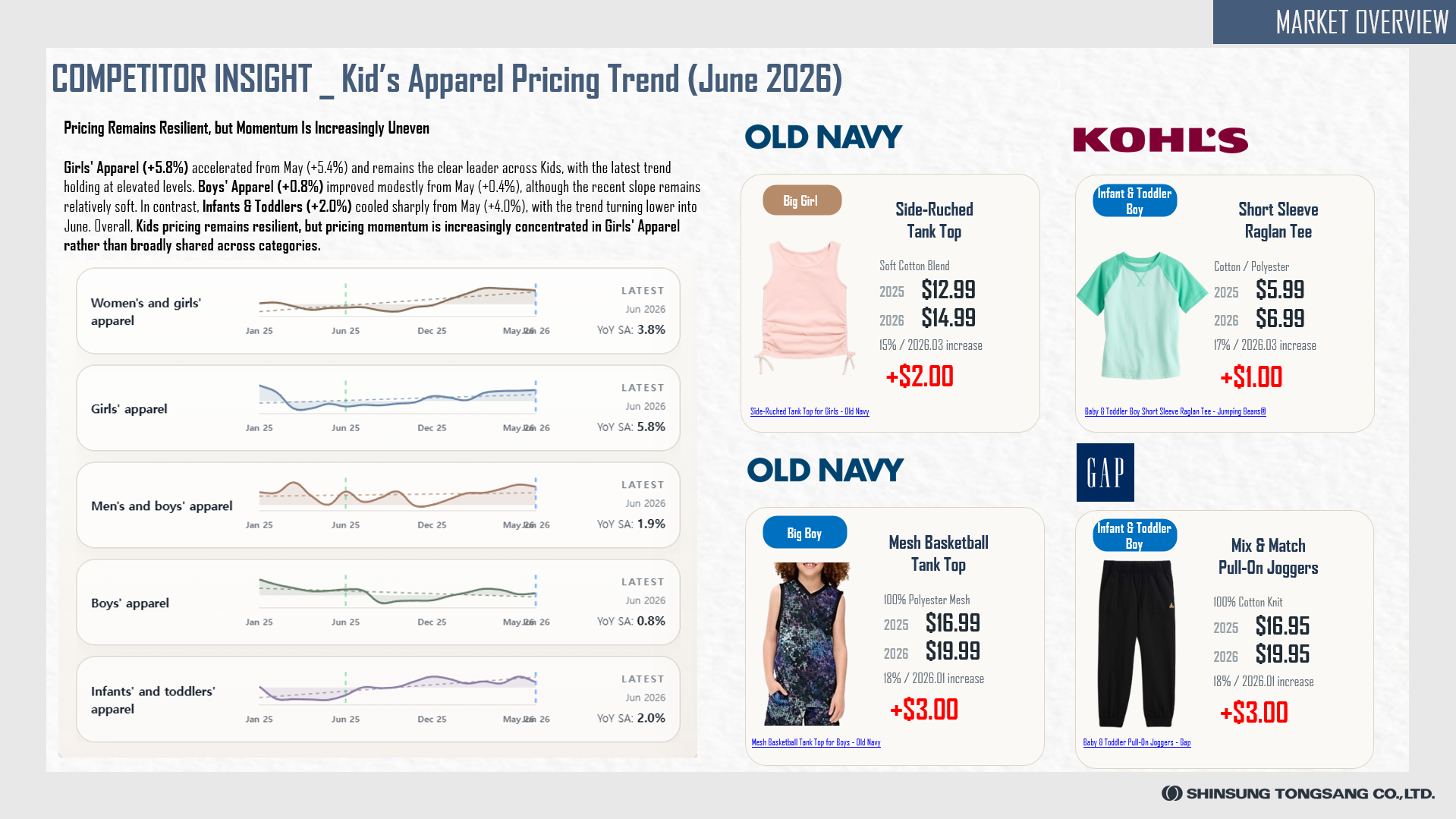
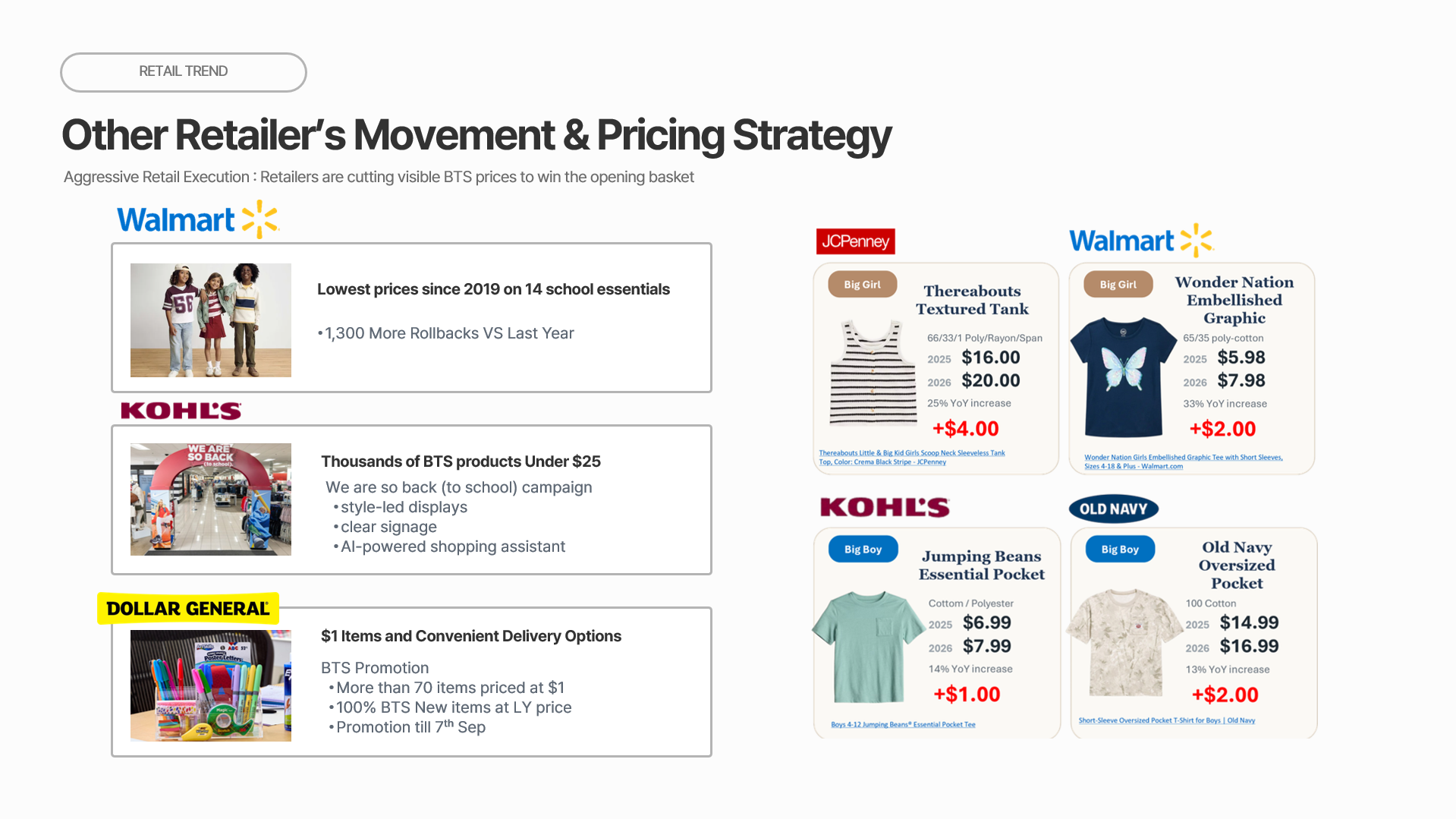
Source : JustStyleTo alleviate household financial burdens during the back-to-school season, Kohl's has made a bold move by significantly lowering the starting price points of its in-house children's apparel brands. Core PB lines like 'Kids' So' and 'Sonoma Goods for Life' were launched at $6.99. Fall items for the best-selling activewear PB 'Tek Gear' are priced under $19.99, ensuring that over 85% of all children's apparel is under $25. They also introduced 'Deal Bar' zones to streamline store layouts by category.
Publication Date: July 14, 2026
Source : WWDWalmart and Sam's Club have rolled back prices on key summer items, with Walmart's thousands of price cuts also including summer fashion apparel. The rollbacks span groceries, daily necessities, outdoor gear, toys, and clothing. This early discount promotion on upcoming fall items is an exceptional strategy designed to capture the budgets of consumers facing economic hardship by offering competitive pricing on essential bulk items.
Publication Date: July 14, 2026
Source : RetaildiveUniqlo's parent company, Fast Retailing, significantly raised its FY2026 earnings guidance following surprise Q3 global results. The company forecasts a 16.7% year-over-year increase in annual revenue and a 28.8% surge in operating profit. Their quality-focused 'LifeWear' strategy, featuring summer cooling apparel and fall Merino wool, has successfully established the brand as a formidable alternative to premium brands in North America and Europe, supported by automated supply chains.
Publication Date: July 14, 2026
Source : Just-styleGlobal denim icon Levi's achieved a surprise earnings beat with an 11% surge in its Direct-to- Consumer (DTC) channel during the second quarter. Driven by this strong DTC performance, the company announced an optimistic revised guidance for 2026 EPS and annual operating cash flow. The successful re-establishment of retro casual and 'loose-fit' denim trends in North America played a key role, allowing their premium denim lines to rotate much more agilely.
Publication Date: July 14, 2026
Source : Just StylePremium footwear powerhouse 'On' is expanding its explosive footwear technological innovation into apparel, achieving a staggering 57.5% surge in Q1 apparel revenue. Utilizing their proprietary 'LightSpray' fiber coating technology, they released premium functional tops that mold perfectly to the skin without needles or thread. By collaborating with top-tier cultural icons like Zendaya and high-end brands like Loewe, 'On' is successfully repositioning itself as a high-end sports lifestyle brand.
Publication Date: July 14, 2026
Source : GlossyUltra-low-cost fast fashion giant Primark reported an explosive 16% year-over-year growth in cumulative Q3 US sales, driven by physical store expansions. Unlike e-commerce-focused competitors, Primark is aggressively opening offline strategic locations. By offering a 'treasure hunt' shopping experience, the brand is rapidly capturing market share among value-seeking American consumers facing inflation, proving the enduring power of physical retail traffic.
Publication Date: July 14, 2026
Source : Retaildive